

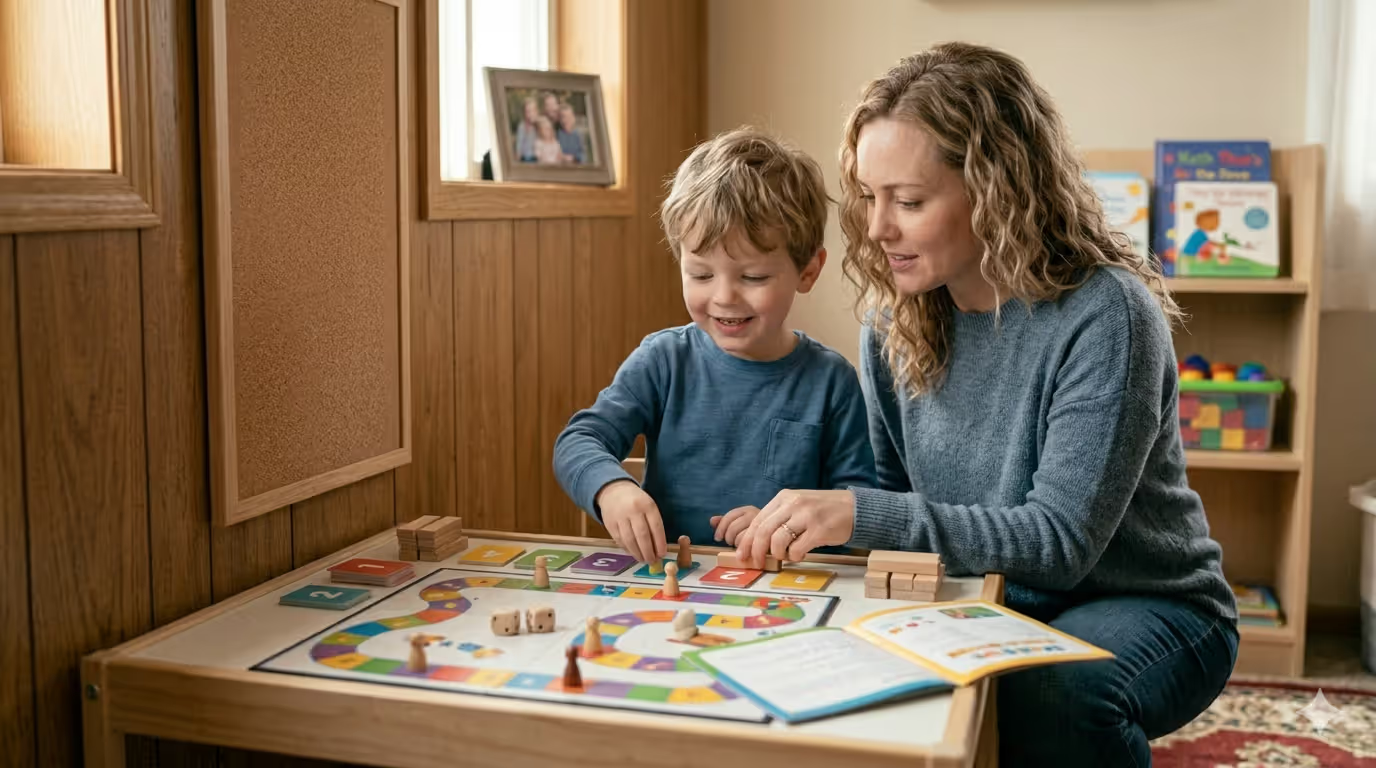
Elementary school child feeling anxious during math homework while parent offers calm support
Math Anxiety in Elementary Students Guide

Content
Every parent has watched their child struggle with homework. But math anxiety is different. It's not just frustration over a tough problem or confusion about fractions. It's a genuine fear response that can make a child's heart race, palms sweat, and mind go blank the moment numbers appear on a page. And it's more common than you might think. Research shows that nearly 20% of elementary students experience significant math anxiety, and that number climbs as kids get older. The good news? Early intervention works. When parents and teachers recognize the signs early and respond with the right strategies, most children can rebuild their relationship with math before it derails their confidence or academic path.
What Math Anxiety Looks Like in Young Children
Math anxiety in children is a specific emotional reaction to mathematical tasks or situations. It's not the same as being "bad at math" or needing extra help with concepts. This is a psychological response where the anticipation or experience of doing math triggers genuine stress and fear.
For elementary-aged kids, this looks different than it does in teenagers or adults. Young children often can't articulate what they're feeling. They won't say "I'm experiencing anxiety about mathematics." Instead, they might complain of stomachaches before math class, become unusually quiet when it's time for homework, or suddenly need to use the bathroom when you pull out flashcards.
The emotional side of learning maths at this age is deeply tied to identity formation. A second-grader who decides "I'm not a math person" is making a judgment that can stick for years. Children this young are concrete thinkers. One bad experience with timed tests or public correction can create a lasting association: math equals failure, embarrassment, or feeling stupid.
What is math anxiety in children, specifically? It's a learned response. Babies aren't born fearing numbers. This develops through experiences, observations, and messages kids absorb from the world around them. A kindergartener who sees a parent panic over helping with math homework learns that math is scary. A third-grader who gets laughed at for a wrong answer learns that math is dangerous socially.
The distinction matters because math anxiety requires different interventions than learning difficulties. A child with dyscalculia needs specialized instruction to process numerical concepts. A child with math anxiety might understand the concepts perfectly but freeze during assessment because their stress response has hijacked their working memory.
Warning Signs Your Child May Have Math Anxiety
Spotting math anxiety early gives you the best chance to turn things around. But the signs aren't always obvious, especially since young kids often hide their struggles or don't realize their reaction isn't typical.

Author: Daniel Merce;
Source: raynet-merseyside.net
Physical and Emotional Symptoms
The body doesn't lie. Even when children can't express their feelings verbally, their physical reactions tell the story.
Watch for complaints of headaches or stomachaches that appear specifically before math activities. These aren't fake. Anxiety produces real physical discomfort. You might also notice sweating, shaking hands when holding a pencil during math work, or rapid breathing.
Emotional responses include sudden tears or anger when faced with math homework. Some kids become unusually clingy or regress to younger behaviors. A confident fourth-grader might suddenly need you to sit right next to them for simple problems they could do independently last month.
Sleep disruption is another red flag. Children worrying about an upcoming math test might have trouble falling asleep or wake up anxious. Some have nightmares about school or tests.
The intensity matters here. All kids get frustrated sometimes. Math anxiety symptoms are disproportionate to the situation and persistent over time.
Behavioral Red Flags in the Classroom and at Home
Behavioral patterns often emerge before academic performance drops. These are the avoidance and coping strategies kids develop to protect themselves from the anxiety trigger.
At home, you might see procrastination specifically around math homework while other subjects get done willingly. Some children "forget" their math books at school repeatedly. Others rush through assignments carelessly just to make the discomfort end faster, leading to sloppy work that doesn't reflect their actual ability.
In the classroom, anxious math learners often avoid participation. They won't raise their hands even when they know answers. During group work, they take passive roles or let others do the calculating. Some kids become class clowns during math time, using humor to deflect from their discomfort.
Grade-level differences matter. Kindergarteners and first-graders might refuse to engage with counting games or hide during math centers. Second and third-graders often develop the "I'm just bad at math" narrative and stop trying. Fourth and fifth-graders might start avoiding advanced math opportunities or requesting schedule changes to get different teachers.
One pattern I see most often is the gap between performance on homework (done with support, untimed) and performance on tests (independent, timed, high-stakes). When homework is consistently better, anxiety is usually part of the picture.
| Math Anxiety vs. Normal Math Struggles: How to Tell the Difference |
| Factor | Normal Math Struggles | Math Anxiety |
| Emotional Response | Frustration, mild stress that passes | Fear, dread, panic that persists beyond the task |
| Physical Symptoms | Occasional tiredness or boredom | Headaches, stomachaches, sweating, shaking specifically with math |
| Onset | Gradual as material gets harder | Can be sudden after a specific event; may appear even with easy material |
| Consistency | Difficulty is consistent across settings | Often performs better in low-pressure situations; freezes during tests |
| Willingness to Try | Will attempt problems with encouragement | Avoids attempting; shuts down before trying |
| Response to Help | Improves with instruction and practice | Understands concepts when calm but can't access knowledge when anxious |
| Duration | Improves as concepts click | Persists even after mastering content; may worsen over time |
Author: Daniel Merce;
Source: raynet-merseyside.net
Why Elementary Students Develop Fear of Numbers
Math anxiety doesn't appear out of nowhere. Specific causes create and reinforce it, and understanding these helps you prevent or reverse the pattern.
Teaching methods play a huge role. Timed tests are a major culprit. When speed becomes the measure of mathematical ability, kids who process more slowly but think deeply get the message that they're failing. The pressure to perform quickly triggers stress responses that actually impair performance, creating a vicious cycle.
Public performance is another classroom factor. Putting problems on the board in front of peers, calling on students randomly, or displaying scores publicly can humiliate struggling learners. One embarrassing moment can create lasting fear.
Parental attitudes transmit directly to children. When parents say "I was never good at math either" or express their own anxiety about helping with homework, kids absorb the belief that math ability is fixed and possibly hereditary. Parents who show visible stress or frustration during homework time teach their children that math is stressful.
This doesn't mean you caused your child's anxiety by admitting math was hard for you. But it's worth examining the messages you might be sending unintentionally.
Learning differences that go unidentified contribute significantly. A child with undiagnosed ADHD might struggle to focus during multi-step problems and conclude they're "stupid at math." A student with working memory challenges might lose track of steps and feel constantly lost. When the real issue isn't addressed, anxiety fills the gap.
Prior negative experiences cement fear. A harsh teacher comment, a failed test displayed with a big red F, or peer teasing about being in the "low math group" can create trauma associations. Young children's brains are wired to remember threats, and social threats (embarrassment, rejection) register as powerfully as physical ones.
Social comparison intensifies in elementary school. Kids start noticing who finishes first, who gets picked for advanced groups, who the teacher praises. Reducing number fear in children means sometimes protecting them from comparisons they're not emotionally ready to process.
Birth order and family dynamics matter too. A younger sibling following an older one who excels at math may develop anxiety from constant comparison. An oldest child might internalize pressure to perform academically.
Math anxiety is not about actual math ability. Many students who experience high levels of math anxiety perform just as well as their non-anxious peers when the pressure is removed. The anxiety itself becomes the barrier, not the mathematical capability.
— Ramirez Gerardo
How Math Anxiety Affects Learning and Development
The consequences of untreated math anxiety extend far beyond elementary school math grades. This shapes educational trajectories, career options, and self-concept in ways that compound over time.
Academic performance takes the most immediate hit. Anxiety literally impairs cognitive function. When the stress response activates, it reduces working memory capacity—the mental workspace you need to solve problems. A child who understands place value perfectly might draw a blank during a test because anxiety has temporarily blocked access to that knowledge.
This creates a painful irony: the more a child cares about doing well, the more anxiety they might experience, which makes them perform worse, which increases anxiety. The cycle reinforces itself.
Long-term educational choices narrow. Students with math anxiety start avoiding advanced math courses as early as middle school. They opt out of STEM pathways not because they lack ability but because they want to avoid the discomfort. This closes doors to careers in engineering, computer science, medicine, economics, and many other fields before kids are old enough to understand the implications.
Research from 2025 tracking students over ten years found that elementary math anxiety predicted college major selection more strongly than actual math achievement did. Students who were objectively good at math but anxious about it still avoided quantitative fields.
Self-esteem suffers broadly, not just in academic contexts. Children who see themselves as "bad at math" often generalize this to "not smart" or "not good at school." The fixed mindset that develops—believing ability is innate rather than developed—affects their approach to all challenges.
Social development can be impacted too. Kids might avoid friendships with peers they perceive as "smarter" or withdraw from academic conversations. Some develop perfectionist tendencies or people-pleasing behaviors to compensate for their perceived math inadequacy.
The gender gap in math anxiety appears early and persists. Girls show higher rates of math anxiety than boys starting around second grade, even when their actual performance is equal or better. Cultural stereotypes about math being a "boy subject" contribute to this disparity and need active counteracting.
Financial literacy in adulthood correlates with childhood math anxiety. Adults who were math-anxious children often avoid dealing with budgets, investments, or financial planning, which has real economic consequences.
But here's what matters most: none of this is inevitable. Early intervention changes outcomes dramatically.
Proven Strategies to Help Your Child Overcome Math Anxiety
Overcoming math anxiety requires patience and consistency, but specific approaches work reliably when applied thoughtfully. You're not trying to make your child love math (though that might happen). You're helping them feel safe and capable when encountering numbers.
Building Math Confidence Through Daily Activities
Math confidence building happens through accumulation of small, successful experiences. The key is removing pressure while maintaining engagement.
Cooking together is one of the best confidence builders. Measuring ingredients, doubling recipes, setting timers—these are authentic math tasks with immediate, tangible results. There's no judgment, no grades, just cookies at the end. A child who freezes at a worksheet might confidently measure flour because the context feels safe.
Shopping provides natural math practice. Let your child calculate unit prices, estimate totals, or figure out discounts. "Which is a better deal?" is a math problem that doesn't feel like one. Hand them cash to pay and count change. Real-world application shows that math has purpose beyond school.
Games remove the "math task" label while building skills. Card games like Uno or Go Fish develop number recognition. Board games with dice teach addition and counting. Strategy games build logical thinking. The crucial element is that these feel like play, not work.
Sports and physical activity integrate math naturally. Keeping score, measuring distances, timing races—all mathematical without triggering anxiety. A child who won't engage with number lines might eagerly track how many seconds they can hold a plank.
Pattern recognition activities build mathematical thinking without obvious "math." Sorting laundry by color, arranging toys by size, creating bead patterns—these develop the categorization and sequencing skills that underlie mathematical reasoning.
The common thread in all these activities is low stakes and high relevance. When children see math as useful and experience success without pressure, confidence grows organically.
Creating Positive Math Experiences at Home
How you approach math at home matters as much as what you do. The emotional environment determines whether practice builds confidence or reinforces anxiety.

Author: Daniel Merce;
Source: raynet-merseyside.net
Eliminate timed pressure at home. Speed is not a mathematical skill. Understanding is. Let your child work at their own pace. If homework has time limits that trigger anxiety, talk to the teacher about modifications.
Praise effort and strategy, not speed or "being smart." Instead of "You're so good at math," try "I noticed you tried a different strategy when the first one didn't work." This reinforces growth mindset and shows that struggle is part of learning, not evidence of failure.
Make mistakes normal and even interesting. When you help with homework, occasionally make deliberate errors and let your child catch them. Say things like "Oops, I messed up—good thing we can fix it." This models that errors are fixable, not catastrophic.
Separate math from judgment. Never use math as punishment ("If you don't finish this, no screen time") or reward ("Finish your math and you can play"). These create associations between math and parental approval/disapproval, raising emotional stakes.
Let your child see you doing math calmly. Narrate when you're calculating tips, measuring for a home project, or planning a schedule. Show that adults use math regularly without drama.
Create a designated, comfortable homework space. Some kids with math anxiety do better at the kitchen table with company nearby. Others need a quiet, private space. Let your child choose what feels safest.
Break homework into smaller chunks with breaks. Twenty minutes of focused work beats an hour of anxious struggle. Use timers not to create pressure but to define work periods: "We'll work for 15 minutes, then take a five-minute break."
When to Seek Professional Support
Sometimes parental support isn't enough, and that's okay. Recognizing when to bring in professionals is part of helping effectively.
Consider professional evaluation if anxiety symptoms are severe, persistent for more than a few months, or worsening despite your interventions. A child psychologist or educational therapist can assess whether there's an underlying learning difference contributing to the anxiety.
Red flags that warrant professional help include panic attacks related to math, school refusal specifically on days with math tests, or physical symptoms (stomachaches, headaches) that interfere with daily functioning.
Math tutoring can help, but choose carefully. The wrong tutor—one who focuses on speed, uses pressure, or doesn't understand anxiety—will make things worse. Look for tutors trained in math anxiety who emphasize understanding over performance and create emotionally safe learning environments.
Cognitive-behavioral therapy (CBT) has strong evidence for treating math anxiety in children. Therapists help kids identify anxious thoughts, challenge them, and develop coping strategies. This addresses the anxiety directly rather than just working around it.
Occupational therapy helps some children, particularly those whose math anxiety connects to fine motor difficulties (trouble writing numbers neatly, lining up columns) or sensory processing issues.
School counselors should be part of your support team. They can facilitate communication between you and teachers, help implement accommodations, and provide in-school coping strategies.
| Age-Appropriate Confidence-Building Activities by Grade Level |
| Grade Level | Activity Examples | Time Commitment | Skills Addressed |
| K-1 | Counting toys during cleanup; sorting snacks by shape/color; simple board games (Chutes and Ladders); measuring ingredients for no-bake recipes | 10-15 min daily | Number recognition, one-to-one correspondence, basic counting, categorization |
| 2-3 | Playing store with play money; measuring heights of family members; card games (War, Crazy Eights); building with blocks and counting pieces; simple cooking with fractions | 15-20 min daily | Addition/subtraction, basic multiplication, money concepts, measurement, fractions introduction |
| 4-5 | Planning shopping lists with budgets; calculating travel times for trips; strategy games (checkers, Connect Four); tracking sports statistics; real cooking with recipe modifications | 20-30 min, 3-4x weekly | Multi-digit operations, fractions, decimals, percentages, problem-solving, logical reasoning |
What Teachers and Schools Can Do to Support Anxious Math Learners
Parents can't solve this alone. Supporting anxious math learners requires school-based interventions that create safer learning environments for vulnerable students.
Classroom accommodations make an enormous difference. Extended time on tests reduces pressure without lowering standards. Private testing locations eliminate the social stress of comparison. Allowing calculators for word problems lets anxious students focus on problem-solving rather than getting stuck on computation anxiety.
Some students benefit from oral testing or demonstrating knowledge through alternative formats. A child who freezes on written tests might confidently explain their thinking aloud.
Teaching approaches that reduce anxiety start with de-emphasizing speed. Not all students need to complete timed drills. Research shows that timed tests increase anxiety without improving mathematical understanding. Teachers can assess fluency through games, observations, or untimed assessments.
Growth mindset language should be explicit and consistent. Teachers who regularly say things like "Your brain grows when you struggle with hard problems" and "Mistakes help us learn" create cultures where anxiety has less room to grow.
Differentiated instruction helps because it reduces comparison. When students work on appropriately challenging material at their own level, there's less obvious ranking. Flexible grouping (changing groups based on specific skills rather than fixed "high" and "low" groups) also reduces stigma.
Incorporating movement and manipulatives, especially in younger grades, gives anxious learners alternative ways to engage. A child who feels lost with abstract numbers might understand perfectly when using counting bears or base-ten blocks.
Teacher attitudes matter profoundly. A teacher who shows warmth, patience, and genuine belief that all students can learn math creates psychological safety. One who expresses frustration, shows favoritism toward quick learners, or uses sarcasm can traumatize vulnerable students.
Communication with parents should be proactive and solution-focused. Teachers who reach out early when they notice signs of anxiety, who listen to parent observations, and who collaborate on strategies create the team approach that works best.
Professional development for teachers on math anxiety should be standard. Many educators don't realize how common it is or how their well-intentioned practices (public problem-solving, timed tests, ability grouping) can trigger or worsen it.
School-wide initiatives can shift culture. Some schools have eliminated timed tests in elementary grades, implemented "mistake of the week" celebrations, or created math clubs focused on puzzles and games rather than competition.
The simpler option usually wins here: when schools prioritize understanding and growth over performance and speed, anxiety naturally decreases.

Author: Daniel Merce;
Source: raynet-merseyside.net
FAQ: Math Anxiety Questions Answered
Math anxiety in elementary students is common, but it's not permanent. The strategies that work best share common elements: they reduce pressure, build genuine understanding, create positive experiences, and address the emotional component directly rather than pretending it doesn't exist.
Your child's relationship with math can change. It happens through small, consistent actions—choosing encouraging words over critical ones, celebrating effort over speed, making math feel relevant and safe. It happens when teachers create classrooms where mistakes are learning opportunities rather than failures, where students work at appropriate challenge levels rather than competing against peers.
Start where you are. You don't need to implement every strategy at once. Pick one or two approaches that feel manageable and build from there. Notice what helps your specific child—every kid responds differently, and you're the expert on yours.
Remember that math anxiety isn't about mathematical ability. It's about fear that's blocking access to ability that's already there. When you remove the fear, you'll often be surprised by what your child can actually do.
The elementary years are the ideal time to intervene. Patterns are still forming. Beliefs are still flexible. Your child still listens to what you say about their capabilities. Use this window to build a foundation of confidence that will serve them long after they've moved beyond addition and subtraction.
Math is a language, a tool, and a way of thinking about the world. Every child deserves to access it without fear. With patience, support, and the right strategies, that's entirely possible.