Imagination shapes thinking
What Is the Preoperational Stage in Child Development?

Content
Jean Piaget changed how we understand childhood. His work in the early 20th century revealed that children don't just know less than adults—they think differently. The preoperational stage sits right in the middle of his developmental theory, capturing those fascinating years when your toddler insists the moon follows them home or believes their stuffed bear gets lonely.
This stage represents a dramatic leap from infancy. Children start using symbols, words, and imagination in ways that seem almost magical. But their thinking still has clear limits. They can't yet grasp another person's perspective or understand that pouring juice into a taller glass doesn't create more juice.
Understanding this stage helps parents and educators work with children's natural development rather than against it. You'll stop wondering why your three-year-old can't share easily or why your four-year-old thinks you can see exactly what they see. It's not stubbornness. It's neurodevelopment.
Age Range and Timeline of the Preoperational Stage
The preoperational stage typically spans from age 2 to 7 years. That's a wide window, and children change dramatically between those bookends.
Piaget identified four major stages of cognitive development. The preoperational stage is the second, sitting between the sensorimotor stage (birth to 2 years) and the concrete operational stage (7 to 11 years). The final stage, formal operational, begins around age 12.
The transition into preoperational thinking usually happens around 18 to 24 months. You'll notice it when your child starts pretending—maybe holding a banana to their ear like a phone or feeding an imaginary snack to a doll. This marks the beginning of symbolic thought, the hallmark of this entire stage.
The exit from this stage is more gradual. Around age 6 or 7, most children start showing concrete operational abilities. They begin understanding conservation (that quantity stays the same despite changes in appearance) and can consider multiple perspectives. But these skills emerge slowly, not overnight.
Some children move through these transitions earlier or later. A child might show concrete operational thinking at 5 in one area but still think preoperationally about other concepts at 8. Development isn't a light switch.
Core Characteristics of Preoperational Thinking
This stage has distinct features that set it apart. Piaget identified several key characteristics that define how preoperational children understand their world.

Author: Daniel Merce;
Source: raynet-merseyside.net
Symbolic Thinking and Pretend Play
Symbolic thinking is the ability to let one thing represent another. A block becomes a car. A stick becomes a magic wand. Words themselves are symbols—the sound "dog" represents the actual animal.
This capacity explodes during the preoperational years. Two-year-olds engage in simple pretend play, like pretending to sleep or eat. By age 4 or 5, children create elaborate fantasy scenarios with multiple characters and storylines.
Drawing also reflects symbolic thinking. Early preoperational children make scribbles they insist represent specific things. Later, they draw recognizable (if simplified) people, houses, and animals. Each line on paper symbolizes something real or imagined.
Language development relies entirely on this symbolic capacity. Children must understand that spoken sounds can represent objects, actions, feelings, and abstract ideas. Without symbolic thinking, language wouldn't be possible.
The pattern I see most often is parents underestimating how important pretend play is. It's not just fun—it's cognitive work. When your child pretends the couch is a pirate ship, they're exercising the same mental muscles they'll use for reading, math, and complex reasoning later.
Egocentrism in Young Children
Egocentrism doesn't mean selfish. In Piaget's framework, it means children can't easily distinguish their own perspective from others' perspectives.
Piaget demonstrated this with his famous "three mountains task." He showed children a model of three mountains from different angles. When asked what a doll sitting on the opposite side would see, preoperational children typically described their own view, not the doll's.
This shows up constantly in daily life. A three-year-old covers their eyes and announces, "You can't see me!" They genuinely believe that if they can't see you, you can't see them. Or they'll hold up a drawing facing themselves and ask, "What is it?" without turning it around for you to see.
Phone conversations reveal this beautifully. A young child might nod silently when Grandma asks a question over the phone, not realizing Grandma can't see the gesture.
Egocentrism also affects emotional understanding. If a child likes chocolate ice cream, they might assume everyone likes chocolate ice cream. They struggle to imagine someone having different preferences or knowledge than they do.
This limitation fades gradually as children approach age 7. They start understanding that others have different thoughts, feelings, and viewpoints. But during the preoperational stage, their own perspective dominates their understanding.

Author: Daniel Merce;
Source: raynet-merseyside.net
Centration and Focus Limitations
Centration means focusing on one aspect of a situation while ignoring others. Children "center" on the most obvious or interesting feature and can't easily consider multiple dimensions simultaneously.
The classic example is Piaget's conservation task. Show a child two identical glasses with equal amounts of water. They'll agree the amounts are the same. Now pour one glass into a taller, thinner container. Preoperational children typically say the tall glass has more water because they center on height and ignore width.
They can't mentally coordinate both dimensions at once. The taller glass must have more because it's taller—that single feature dominates their thinking.
This happens with number too. Spread out a row of five coins so they take up more space than a clustered group of five coins. Young children often say the spread-out row has more coins. They center on length and ignore density.
Centration affects problem-solving across domains. If you change one thing about an object, preoperational children may think you've changed everything about it. Put Dad's hat on Mom, and a young child might insist that's Dad, not Mom.
By age 7 or so, children develop "decentration"—the ability to consider multiple aspects simultaneously. This marks the transition to concrete operational thinking.
Animism and Magical Thinking
Animism is the belief that inanimate objects have feelings, intentions, or consciousness. To a preoperational child, the sun is happy, the wind is angry, and the car is tired.
This isn't confusion exactly. It's a natural extension of how children understand the world. They're alive and have feelings, so why wouldn't other things? The boundaries between living and non-living aren't clear yet.
A four-year-old might apologize to a table after bumping into it. They might insist their stuffed animals need to be tucked in carefully so they won't be cold. The moon follows them in the car because it wants to watch them.
Magical thinking goes hand-in-hand with animism. Children believe their thoughts or wishes can directly affect reality. If they wish hard enough, maybe it'll snow tomorrow. If they think bad thoughts, maybe something bad will happen.
This explains why young children often develop rituals or superstitions. Stepping on a crack might genuinely seem dangerous. Wearing a particular shirt might seem necessary for good luck.
These beliefs typically fade as children approach age 7 and develop more logical thinking. They start distinguishing between fantasy and reality more clearly, though remnants of magical thinking can persist even into adulthood.

Author: Daniel Merce;
Source: raynet-merseyside.net
Language Development During the Preoperational Stage
Language growth during these years is explosive. Most children enter this stage with a vocabulary of 50 to 200 words. By age 6, many know 10,000 words or more.
The "vocabulary spurt" typically happens around 18 to 24 months. Suddenly children start learning new words at an astonishing rate—sometimes several per day. This acceleration continues throughout the preoperational years, though the pace varies by child and environment.
Grammar develops rapidly too. Two-year-olds use two-word combinations: "More juice," "Daddy go," "Big truck." By age 3, they're constructing full sentences with subjects, verbs, and objects. Four-year-olds use complex sentences with multiple clauses. Five-year-olds tell coherent stories with beginnings, middles, and ends.
But language limitations reflect the broader cognitive constraints of this stage. Preoperational children struggle with abstract concepts that can't be directly observed. Words like "justice," "democracy," or "metaphor" don't make much sense yet.
They also interpret language very literally. Tell a four-year-old "Hold your horses," and they might look around confused, wondering where the horses are. Idioms, sarcasm, and figurative language often fly right over their heads.
Questions become a major tool for learning. The infamous "Why?" phase peaks during this stage. Children ask endless questions, sometimes repeating the same one multiple times because they're still processing the answer.
Overgeneralization errors are common and actually show learning in progress. A child learns that adding "-ed" makes past tense, so they say "goed" instead of "went" or "runned" instead of "ran." They're applying a rule they've figured out, even though English has irregular exceptions.
Private speech—talking aloud to themselves—is typical and helpful. Children often narrate their actions or think through problems verbally. This self-talk helps them organize thoughts and regulate behavior. It usually becomes internalized as silent inner speech by age 7 or 8.
Real-World Examples of Preoperational Thought
Abstract descriptions only go so far. Here's what preoperational thinking looks like in everyday situations.
Egocentrism in action: Maya, age 4, picks out a toy truck as a birthday present for her grandmother. Maya loves trucks, so obviously Grandma will too. When asked what Grandma might like, Maya can't step outside her own preferences to consider that Grandma might prefer something different.
Animism at bedtime: Liam, age 3, insists his stuffed elephant must sleep with its head on a pillow because "He gets a sore neck just like me." When his parents suggest leaving the elephant in the toy box, Liam becomes upset, worried the elephant will be lonely and scared in the dark.
Centration with snacks: Two siblings, both in the preoperational stage, are given cookies. One child's cookie breaks into several pieces. Despite having the same amount of cookie, the child with pieces insists they have more because there are "more cookies" (focusing on number of pieces, not total amount).
Magical thinking about weather: Emma, age 5, wore her rainbow shirt on a sunny day. The next time it rains, she refuses to wear that shirt, convinced that wearing it will "make it rain again." Her parents' logical explanations don't override her belief in the connection.
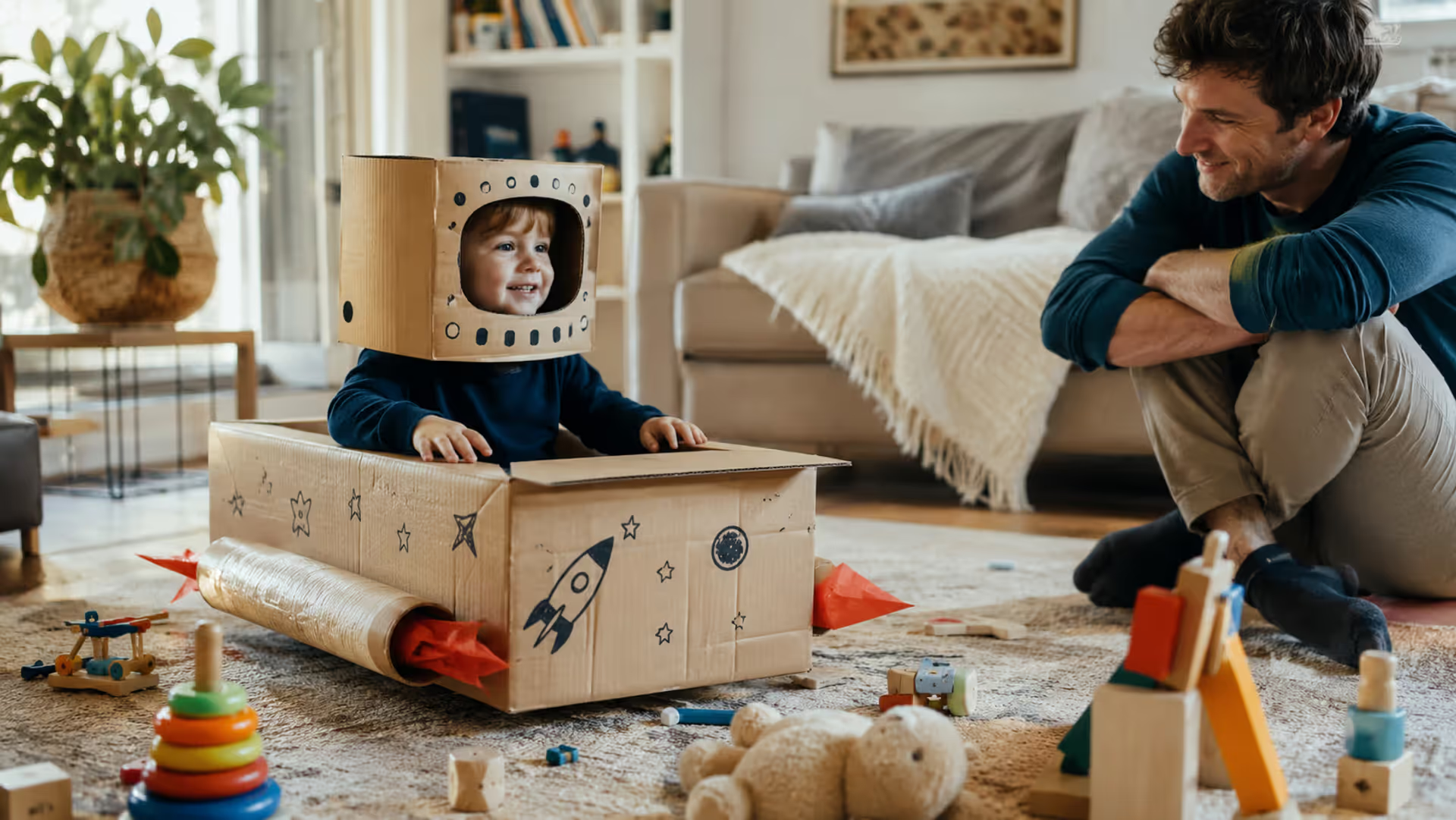
Symbolic play scenario: A group of four-year-olds turns a cardboard box into a spaceship. They assign roles (captain, astronaut, alien) and create an elaborate story about traveling to Mars. The box doesn't look like a spaceship, but they've agreed it symbolizes one, and that's enough.
Language literalism: Dad tells five-year-old Noah, "I'm so hungry I could eat a horse." Noah looks horrified and asks, "Which horse? Not the one at the farm we visited?" He can't yet understand the exaggeration as figurative speech.
Conservation failure: A teacher pours juice from a short, wide cup into a tall, thin glass in front of a classroom of preoperational children. Most insist the tall glass now has more juice, even though they watched the same juice being poured. The height difference is too compelling to ignore.
These examples show that preoperational thinking isn't "wrong"—it's developmentally appropriate. Children are working with the cognitive tools they have.
Activities That Support Preoperational Development
Author: Daniel Merce;
Source: raynet-merseyside.net
You can't rush development, but you can provide experiences that support natural growth during this stage.
Pretend play opportunities: Stock a dress-up box with costumes, props, and accessories. Create spaces for different types of play—a "kitchen" area, a "doctor's office," a "construction site." Join in occasionally, but let children lead the narrative. This builds symbolic thinking and creativity.
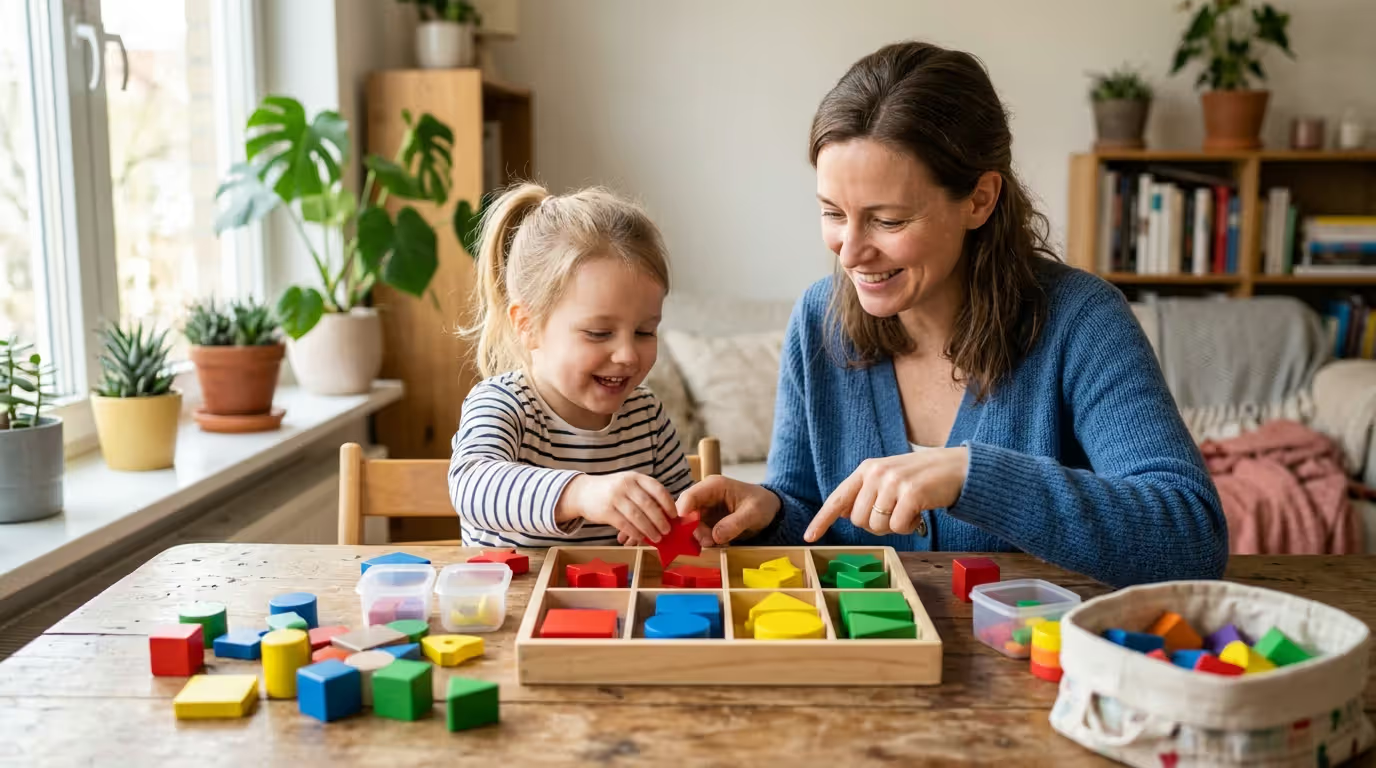
Sorting and categorizing games: Provide buttons, shells, or blocks in various colors, sizes, and shapes. Ask children to sort them in different ways. This helps them think about multiple attributes and begins challenging centration, though full decentration won't come until later.
Perspective-taking practice: Read books and ask, "How do you think that character feels?" or "What does the character know that the other one doesn't?" This gently introduces the idea that different people have different thoughts and feelings, working against egocentrism.
Conservation experiments: Let children pour water between different containers, play with clay in different shapes, or arrange objects in different configurations. Don't expect them to "get" conservation yet, but the hands-on experience builds familiarity with transformations.
Story creation: Encourage children to tell stories, draw pictures and explain them, or dictate stories for you to write down. This develops symbolic thinking, language skills, and narrative understanding simultaneously.
Nature observation: Point out living versus non-living things during walks. "The tree is alive—it grows and needs water. The rock isn't alive—it doesn't grow or need food." This helps clarify animistic thinking, though young children will still personify objects.
Simple board games: Games with basic rules help children practice turn-taking and following sequences. They also begin to understand that rules apply to everyone, not just themselves—a step away from egocentrism.
Open-ended art materials: Crayons, markers, paint, playdough, and craft supplies let children represent ideas symbolically. A blue scribble might be the ocean. A playdough ball might be a birthday cake. The representation matters more than the realism.
The simpler option usually wins here. Elaborate educational toys aren't necessary. A cardboard box, some markers, and imagination often provide richer developmental experiences than expensive electronic toys.
Common Misunderstandings About This Stage
Several myths about preoperational thinking persist, even among well-meaning parents and educators.
Myth: Children are being difficult when they can't share. Reality: Sharing requires understanding another person's desires and coordinating multiple perspectives (yours and theirs). Egocentrism makes this genuinely difficult, not a character flaw. Forced sharing before children are ready can actually backfire.
Myth: You should correct magical thinking immediately. Reality: Some magical thinking is developmentally normal and even beneficial. It fuels creativity and imagination. Unless it's causing fear or problems, there's no need to aggressively stamp it out. It'll fade naturally.
Myth: Children who talk to stuffed animals are confused about reality. Reality: Most children know their toys aren't actually alive, but they enjoy pretending. This is healthy symbolic play, not delusion. Even adults engage in similar behavior—think about people talking to pets or plants.
Myth: Preoperational children can't learn anything abstract. Reality: They can't handle highly abstract concepts, but they can begin learning simplified versions. You can introduce ideas like fairness, kindness, or numbers through concrete examples and stories. The key is matching the abstraction level to their abilities.
Myth: All preoperational children are the same. Reality: The 2-to-7 age range covers enormous developmental ground. A 2-year-old and a 6-year-old are both preoperational but vastly different in abilities. Individual variation is also huge—some children show certain skills earlier or later than average.
Myth: You can teach conservation through explanation. Reality: Piaget believed conservation understanding emerges from maturation and experience, not direct teaching. You can provide experiences, but lecturing a 4-year-old about why the amount of water stays the same won't create understanding before they're ready.
Myth: Egocentrism means selfishness. Reality: These are completely different. A preoperational child can be generous and kind while still being cognitively egocentric. They might share a toy while simultaneously assuming you see exactly what they see.
One common mistake is comparing children too rigidly to developmental milestones. These stages describe general patterns, not strict rules. Some children transition earlier, some later, and that's typically fine.
Author: Daniel Merce;
Source: raynet-merseyside.net
Comparison of Piaget's Four Stages
| Stage | Age Range | Key Abilities | Main Limitations |
| Sensorimotor | Birth–2 years | Object permanence, basic cause-and-effect, sensory exploration, simple problem-solving | No symbolic thought, no language, thinking tied to immediate sensory experience |
| Preoperational | 2–7 years | Symbolic thinking, language development, pretend play, mental representation | Egocentrism, centration, lack of conservation, animism, magical thinking |
| Concrete Operational | 7–11 years | Logical thinking about concrete objects, conservation, reversibility, classification, decentration | Difficulty with abstract or hypothetical concepts, thinking tied to concrete reality |
| Formal Operational | 12+ years | Abstract reasoning, hypothetical thinking, systematic problem-solving, metacognition | Not all individuals fully develop formal operational thinking; abstract reasoning varies |
This table shows the progression of cognitive abilities across childhood and adolescence. Each stage builds on the previous one, with new capabilities emerging while limitations gradually fade.
The principal goal of education in the schools should be creating men and women who are capable of doing new things, not simply repeating what other generations have done.
— Piaget Jean
FAQ: Preoperational Stage Questions Answered
The preoperational stage represents a remarkable period of growth. Children transform from toddlers who barely speak into kindergarteners who tell elaborate stories, ask endless questions, and create imaginary worlds.
Understanding this stage helps you set realistic expectations. You'll stop wondering why your four-year-old can't see things from your perspective or why explanations about conservation don't stick. These aren't failures—they're normal developmental patterns.
This knowledge also helps you provide appropriate support. Instead of fighting against egocentrism, you can gently introduce perspective-taking through stories and conversations. Instead of being frustrated by magical thinking, you can appreciate its role in creativity while gradually introducing more logical explanations.
Remember that development happens on its own timeline. Some children show certain abilities earlier, others later. Wide variation is normal and expected. Your child isn't competing with developmental charts—they're following their own path.
The activities and interactions you provide during these years matter, but not because they'll rush your child to the next stage. They matter because they enrich the current stage, building a strong foundation for future learning. Pretend play, conversations, hands-on exploration, and creative expression all support the cognitive growth happening naturally in your child's developing brain.
By age 7 or so, most children transition into concrete operational thinking. They'll understand conservation, consider multiple perspectives, and think more logically about the physical world. But those preoperational years—with their magical thinking, creative play, and unique logic—are irreplaceable. They're not a problem to solve or a phase to rush through. They're a vital part of becoming a thinking, reasoning human being.