How thinking changes with age
Piaget Stages of Development Explained

Content
Understanding how children think isn't just academic theory. It shapes how we teach, parent, and support young minds every day. Jean Piaget, a Swiss psychologist who spent decades observing children, gave us a framework that still influences education and child psychology across the United States and beyond. His stages of cognitive development describe how kids don't just know less than adults—they actually think differently. Their brains process information in ways that change dramatically as they grow. If you've ever wondered why a three-year-old insists the moon follows them or why abstract algebra suddenly clicks for some teens, Piaget's theory offers answers. Let's break down what he discovered and why it still matters in 2026.
What Is Piaget's Theory of Cognitive Development?
Jean Piaget started his career studying mollusks, not children. But after working in Alfred Binet's lab in Paris, he became fascinated by the wrong answers kids gave on intelligence tests. He noticed patterns. Children of similar ages made the same types of errors, suggesting they weren't just less knowledgeable—they were reasoning differently.
Piaget's theory of cognitive development proposes that children move through four distinct stages as their thinking evolves. Each stage represents a fundamentally different way of understanding the world. You can't skip stages or rush through them by cramming information into a child's head. The brain needs time and experience to build new mental structures.
The Jean Piaget theory rests on a simple but powerful idea: children actively construct their understanding through interaction with their environment. They're not passive sponges absorbing facts. They're little scientists running experiments, testing hypotheses, and revising their mental models based on results.
This matters because it changed education. Before Piaget, many educators treated children as miniature adults who simply needed more information. His work showed that a seven-year-old can't grasp certain abstract concepts no matter how clearly you explain them. Their brain isn't ready yet. And that's normal.
Piaget's cognitive development research spanned over 60 years, from the 1920s through the 1980s. He observed thousands of children, including his own three kids, documenting how they solved problems, played, and made sense of their experiences.
The Four Stages of Cognitive Development
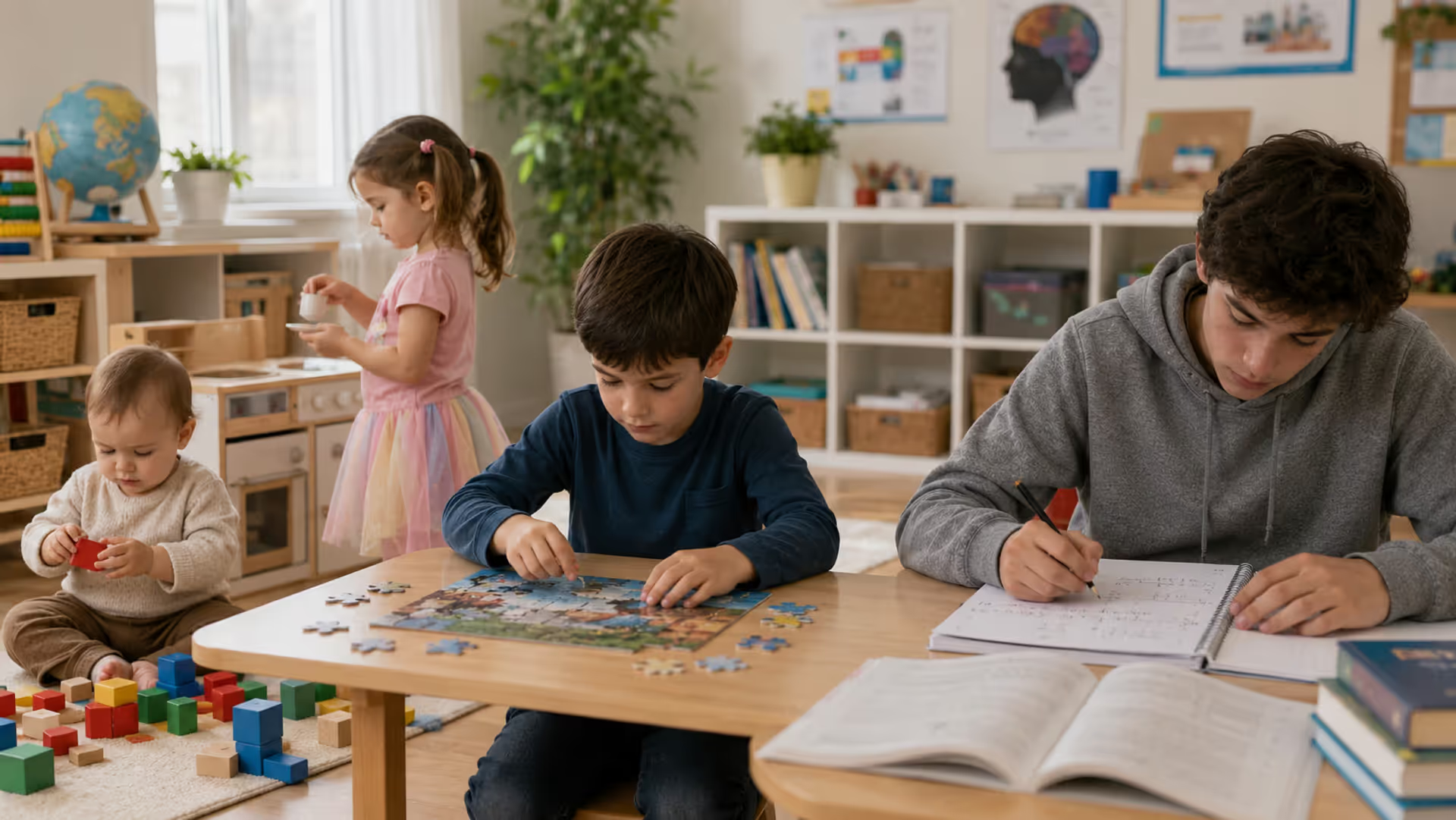
The stages of cognitive development form the backbone of Piaget's framework. Each stage builds on the previous one, creating increasingly sophisticated ways of thinking. The age ranges are approximate—individual children vary—but the sequence stays the same.
Here's what you need to know about each stage.
Sensorimotor Stage (Birth to 2 Years)
Babies live entirely in the present moment. What they can see, touch, taste, or hear is their whole world. Out of sight literally means out of mind during the early months.
The sensorimotor stage is all about learning through physical interaction. Infants explore by mouthing objects, shaking rattles, and dropping things repeatedly (much to parents' exhaustion). They're building basic understanding of cause and effect, spatial relationships, and object permanence.
Object permanence develops around 8 to 12 months. Before this, if you hide a toy under a blanket, the baby acts like it ceased to exist. After this milestone, they'll search for hidden objects because they've grasped that things continue to exist even when invisible.
By age two, most toddlers can hold mental images of objects and people. They start pretend play. They can think about things that aren't immediately present. This marks the transition to symbolic thinking.

Author: Hannah Whitaker;
Source: raynet-merseyside.net
Preoperational Stage (2 to 7 Years)
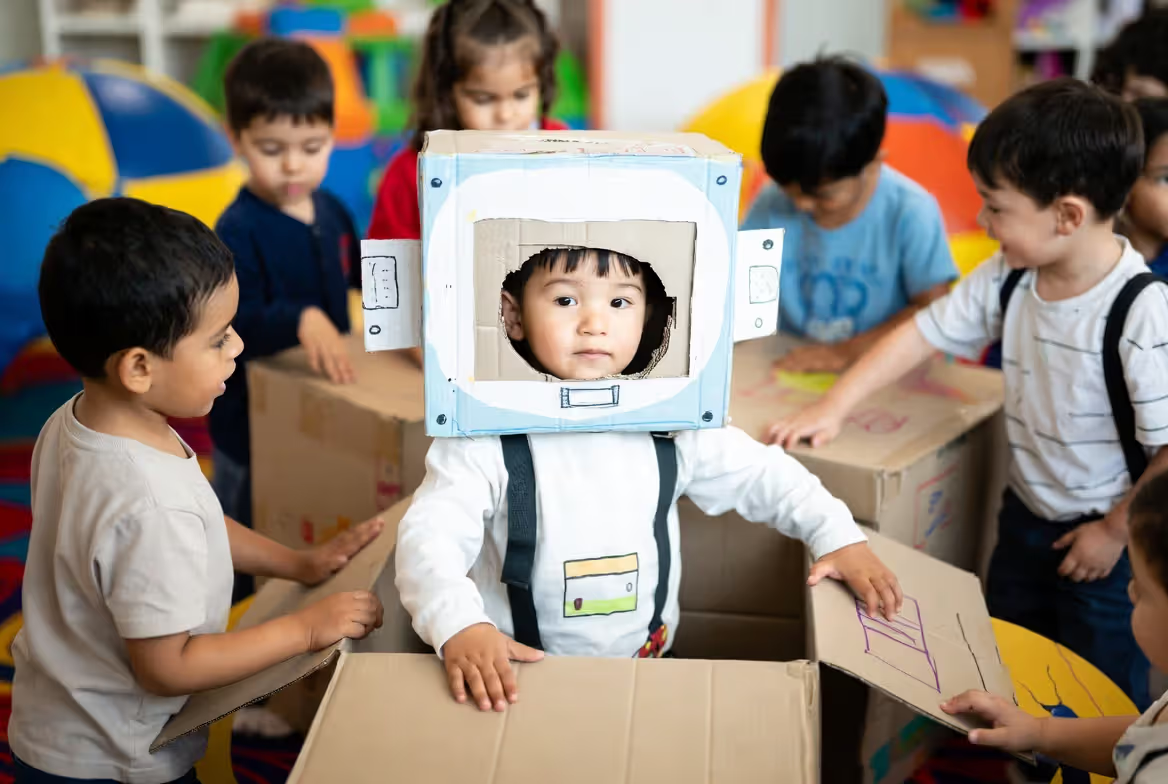
Language explodes during this stage. Kids can now use words and images to represent objects and ideas. They engage in elaborate pretend play—a stick becomes a sword, a cardboard box transforms into a spaceship.
But their thinking has quirky limitations. Preoperational children are egocentric, meaning they struggle to see situations from perspectives other than their own. Ask a four-year-old to show you their drawing, and they might hold it facing themselves because they can't easily imagine what you see.
They also lack conservation—the understanding that quantity stays the same despite changes in appearance. Pour juice from a short, wide glass into a tall, thin one, and a five-year-old will often insist the tall glass now has more juice. The visual change overwhelms their logic.
Centration is another hallmark. They focus on one aspect of a situation while ignoring others. Show them a row of coins spread out and another row bunched together (with the same number), and they'll say the longer row has more. They're centering on length alone.
Author: Hannah Whitaker;
Source: raynet-merseyside.net
Concrete Operational Stage (7 to 11 Years)
Logic arrives, but it's tied to concrete, tangible situations. Children in the concrete operational stage can now conserve, classify, and think about cause and effect in systematic ways.
They master conservation of number, mass, and volume. The juice-in-different-glasses trick no longer fools them. They understand that rearranging objects doesn't change their quantity.
Reversibility becomes possible. They can mentally reverse actions—if you add water to a container, they can imagine pouring it back out. This allows for more sophisticated math skills like subtraction as the inverse of addition.
Classification improves dramatically. They can sort objects by multiple attributes and understand hierarchical relationships. A dog is both a poodle and an animal simultaneously—a concept that confuses younger children.
But abstract and hypothetical thinking remains difficult. Ask a concrete operational child, "What if gravity worked backwards?" and they'll struggle. They need real objects and actual experiences to reason effectively.

Author: Hannah Whitaker;
Source: raynet-merseyside.net
Formal Operational Stage (11 Years and Beyond)
Abstract thinking finally emerges. Teens in the formal operational stage can reason about hypotheticals, test theories systematically, and think about thinking itself (metacognition).
They can handle "if-then" logic without concrete examples. Algebra makes sense because they can manipulate abstract symbols. They can consider multiple variables simultaneously and design controlled experiments to test hypotheses.
The formal operational stage also brings idealism and philosophical thinking. Teens start questioning authority, imagining perfect societies, and pondering abstract concepts like justice, identity, and morality.
Not everyone fully develops formal operational thinking, though. Research since Piaget's time shows that many adults struggle with abstract reasoning in unfamiliar domains. You might think abstractly about your profession but revert to concrete thinking when learning something completely new.

Author: Hannah Whitaker;
Source: raynet-merseyside.net
| Stage | Age Range | Key Characteristics | Cognitive Abilities | Limitations | Real-World Example |
| Sensorimotor | Birth–2 years | Learning through senses and movement | Object permanence, basic cause-effect, goal-directed actions | No symbolic thought, lives in present moment | Baby searches for toy hidden under blanket |
| Preoperational | 2–7 years | Symbolic thinking, language development | Pretend play, language use, mental imagery | Egocentrism, lacks conservation, centration | Child thinks tall glass has more juice than wide glass with same amount |
| Concrete Operational | 7–11 years | Logical thinking about concrete situations | Conservation, classification, reversibility, seriation | Struggles with abstract and hypothetical concepts | Student solves math problems with physical objects but struggles with algebraic concepts |
| Formal Operational | 11+ years | Abstract and hypothetical reasoning | Systematic problem-solving, deductive logic, metacognition | Not universally achieved, may not apply across all domains | Teen debates ethical dilemmas and considers multiple perspectives |
Key Concepts in Piaget's Cognitive Development Theory
Piaget didn't just describe stages. He explained the mechanisms driving cognitive growth. Four concepts form the engine of his theory: schemas, assimilation, accommodation, and equilibration.
Schemas are mental frameworks that organize knowledge. Think of them as filing systems in the brain. A toddler might have a "dog" schema that includes four legs, fur, and barking. Schemas help us make sense of new experiences by connecting them to what we already know.
Assimilation happens when you fit new information into existing schemas. A child with a dog schema sees a cat for the first time and calls it a dog. They're assimilating the cat into their existing framework because it shares similar features.
Accommodation occurs when existing schemas can't handle new information, so you modify them or create new ones. When someone corrects the child—"That's a cat, not a dog"—they accommodate by adjusting their schema or creating a separate cat schema with different characteristics.
The pattern I see most often is parents trying to force accommodation before children are ready. You can't explain quantum physics to a six-year-old through accommodation alone. Their schemas aren't developed enough to accommodate that level of abstraction.
Equilibration is the balance between assimilation and accommodation. When new experiences conflict with existing schemas, you feel cognitive disequilibrium—mental discomfort. This drives learning. You're motivated to restore equilibrium by either assimilating the experience or accommodating your schemas.
Here's a practical example: A child believes all birds fly (schema). They see a penguin at the zoo (new experience). This creates disequilibrium because penguins don't match the flying-bird schema. They might initially deny penguins are birds (assimilation attempt) or revise their schema to "birds have feathers and beaks, but not all fly" (accommodation). Equilibration is achieved when the new, more accurate schema feels stable.
This process repeats constantly as children interact with their world. Each cycle builds more complex, nuanced understanding.
How Piaget's Stages Apply to Modern Child Development

Author: Hannah Whitaker;
Source: raynet-merseyside.net
Piaget's developmental stages aren't just theory gathering dust in psychology textbooks. They inform real practices in education, parenting, and child psychology throughout the United States in 2026.
In education, teachers use Piaget's stages to match instruction to cognitive readiness. Elementary schools emphasize hands-on learning with manipulatives because young children need concrete experiences. You'll see first-graders using counting blocks rather than abstract number lines. Middle schools gradually introduce more abstract concepts as students enter formal operations.
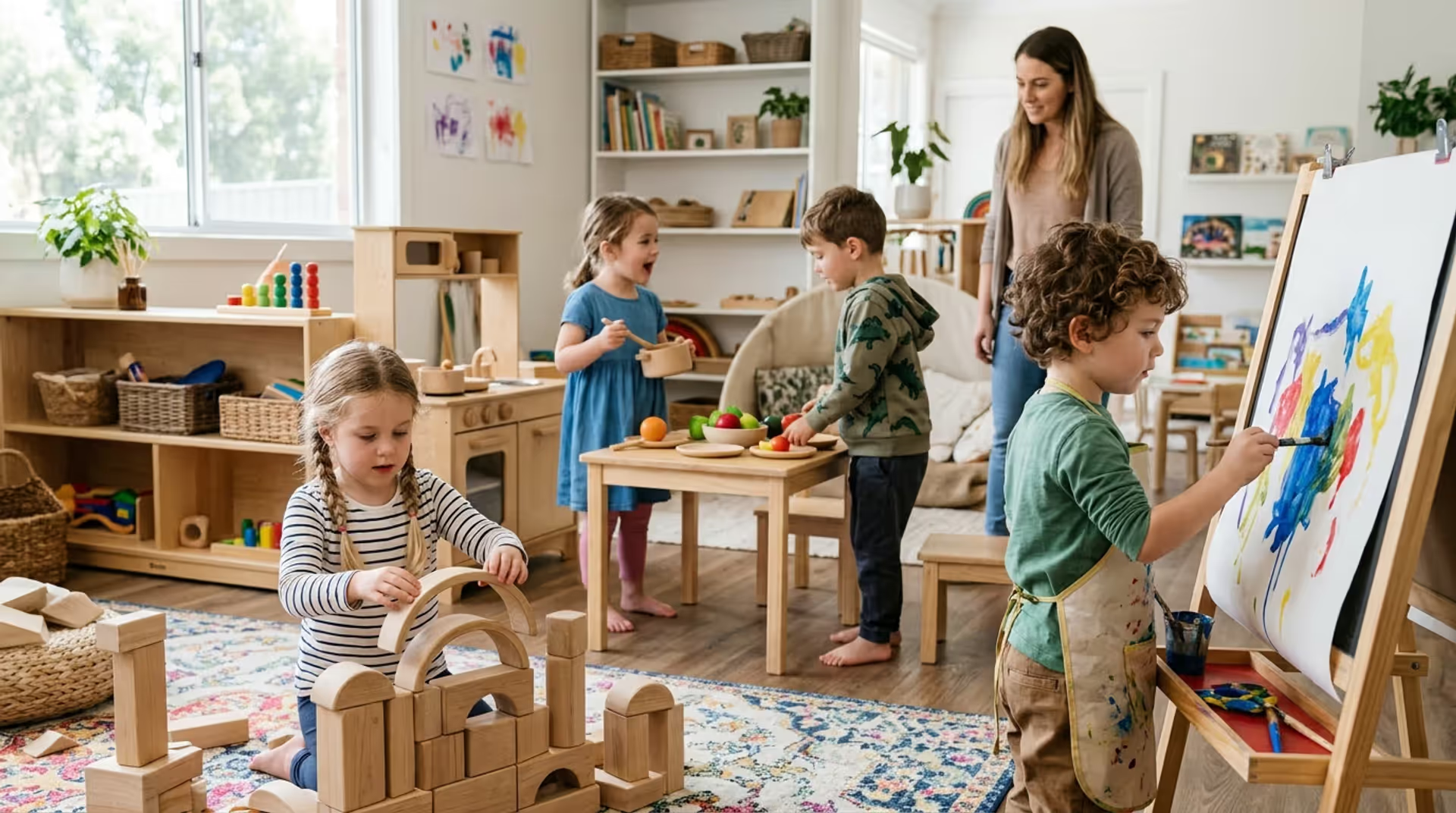
The Montessori method, popular across thousands of US schools, incorporates Piagetian principles. Children learn through self-directed exploration with age-appropriate materials designed to create optimal disequilibrium—challenging enough to promote growth but not so difficult they cause frustration.
In parenting, understanding cognitive development in children helps set realistic expectations. You won't waste energy trying to reason with a tantruming three-year-old about why they can't have candy before dinner. Their preoperational thinking can't handle that level of delayed gratification and abstract reasoning. Instead, you might offer a concrete choice between two acceptable options.
Parents also use stage knowledge to provide appropriate challenges. If your eight-year-old is in concrete operations, you might introduce cooking to teach fractions through measuring cups—connecting abstract math to tangible experiences.
In child psychology and therapy, clinicians assess whether children are progressing through Piaget's developmental stages typically. Significant delays might indicate cognitive disabilities or environmental factors requiring intervention. Play therapy often leverages stage-appropriate activities to help children process experiences they can't yet verbalize.
One common mistake is assuming all children hit milestones at exactly the ages Piaget specified. They don't. The stages describe a sequence, not a strict timeline. Some kids enter formal operations at nine; others at thirteen. Both are normal.
The principal goal of education in the schools should be creating men and women who are capable of doing new things, not simply repeating what other generations have done.
— Piaget Jean
Criticisms and Limitations of Piaget's Developmental Stages
Piaget's cognitive development theory revolutionized child psychology, but it's not perfect. Decades of research since his death in 1980 have revealed important limitations.
Cultural bias is a significant concern. Piaget studied primarily Swiss children from educated families. His tasks and interpretations reflected Western, educated values. Research in non-Western cultures shows children may demonstrate cognitive abilities earlier or later depending on what their culture emphasizes. For example, children in societies that value spatial navigation often develop related concrete operational skills earlier than Piaget predicted.
Underestimation of abilities is another criticism. Modern researchers using different methods have shown that infants and young children are more cognitively capable than Piaget believed. Babies as young as three months show surprise when objects seem to disappear, suggesting some understanding of object permanence earlier than Piaget claimed. The original tasks may have been too complex motorically, masking cognitive abilities.
Renée Baillargeon's research in the 1980s and 1990s used looking-time methods to demonstrate that infants understand basic physics much earlier than Piaget's stages suggested. They don't have the motor skills to search for hidden objects, but they're cognitively aware those objects still exist.
Timing variations are substantial. Not all adults achieve formal operational thinking, and those who do don't apply it consistently across domains. You might reason abstractly about your profession but think concretely about car mechanics or cooking. Piaget treated stages as universal structures, but expertise and context matter more than he acknowledged.
Social factors play a larger role than Piaget recognized. Lev Vygotsky, a contemporary of Piaget, emphasized that cognitive development happens through social interaction and cultural tools like language. Vygotsky's sociocultural theory suggests children can perform at higher levels with guidance from more knowledgeable others—a concept Piaget largely overlooked.
Continuous vs. stage-like development remains debated. Some researchers argue cognitive growth is more gradual and continuous than Piaget's distinct stages suggest. Children might show formal operational thinking in familiar contexts while still using concrete operations in unfamiliar ones, blurring stage boundaries.
Despite these limitations, Piaget's core insights remain valuable. Children do think differently than adults. Development does follow a general sequence. And active exploration does drive learning. Modern developmental psychology builds on Piaget's foundation while correcting his oversights.
FAQ: Piaget's Stages of Development Questions Answered
Piaget gave us a lens for seeing childhood not as incomplete adulthood but as a series of distinct ways of experiencing reality. A toddler isn't a defective teenager. They're operating with a different cognitive system entirely.
This matters when you're teaching a child to read, explaining why they can't have dessert first, or designing educational apps. Meeting kids where they are cognitively—not where you wish they were—makes everything easier.
The stages aren't rigid boxes. They're guideposts. Your seven-year-old might show flashes of abstract thinking while still needing concrete examples most of the time. That's normal. Development is messy and individual.
What Piaget got right is that children are active meaning-makers. They're not waiting for you to fill their heads with facts. They're constantly testing, questioning, and revising their understanding. Your job is to provide rich experiences that create productive disequilibrium—challenges that push them just beyond their current schemas.
So watch how children interact with their world. Notice what confuses them. See where they're ready for the next step. That's Piaget's real gift: teaching us to pay attention to how children think, not just what they know.