
Ofsted Ratings Guide to School Grades

Content
Thinking about relocating to the UK? Or maybe you're just curious how school quality gets measured across the pond? Either way, you'll run into Ofsted ratings pretty quickly. These grades pop up everywhere—school websites, property listings, neighborhood Facebook groups. But here's the question: what are you actually looking at when you see "Outstanding" or "Requires Improvement"? And what's hidden behind those labels? I'll walk you through how England's school inspection system actually works, what those ratings reveal, and—just as important—what they leave out.
What Is Ofsted and Why Do School Ratings Matter?
Ofsted is England's education watchdog—the Office for Standards in Education, Children's Services and Skills, if you want the full name. This independent government agency inspects schools, nurseries, and some training programs across England. Unlike the US, where each state runs its own education oversight, England operates under one national inspection framework.
Here's why these ratings pack such a punch: Parents base school choices on them. Property prices actually shift depending on whether you're in the catchment zone for a highly-rated school. Schools themselves face real consequences. Top-rated schools earn more freedom to operate independently. Schools at the bottom? They might get forced into academy chains or see their entire leadership team replaced.
If you're an American family planning a UK move, these ratings become your first filter when researching neighborhoods. They're public, standardized across the country, and seem straightforward at first glance.
But here's where it gets interesting—Ofsted ratings don't function like GreatSchools scores or your state's report card system back home. Inspections happen less frequently, dig deeper into classroom practices, and blend qualitative observations with hard data rather than relying purely on test scores.
The Ofsted School Inspection Process Explained
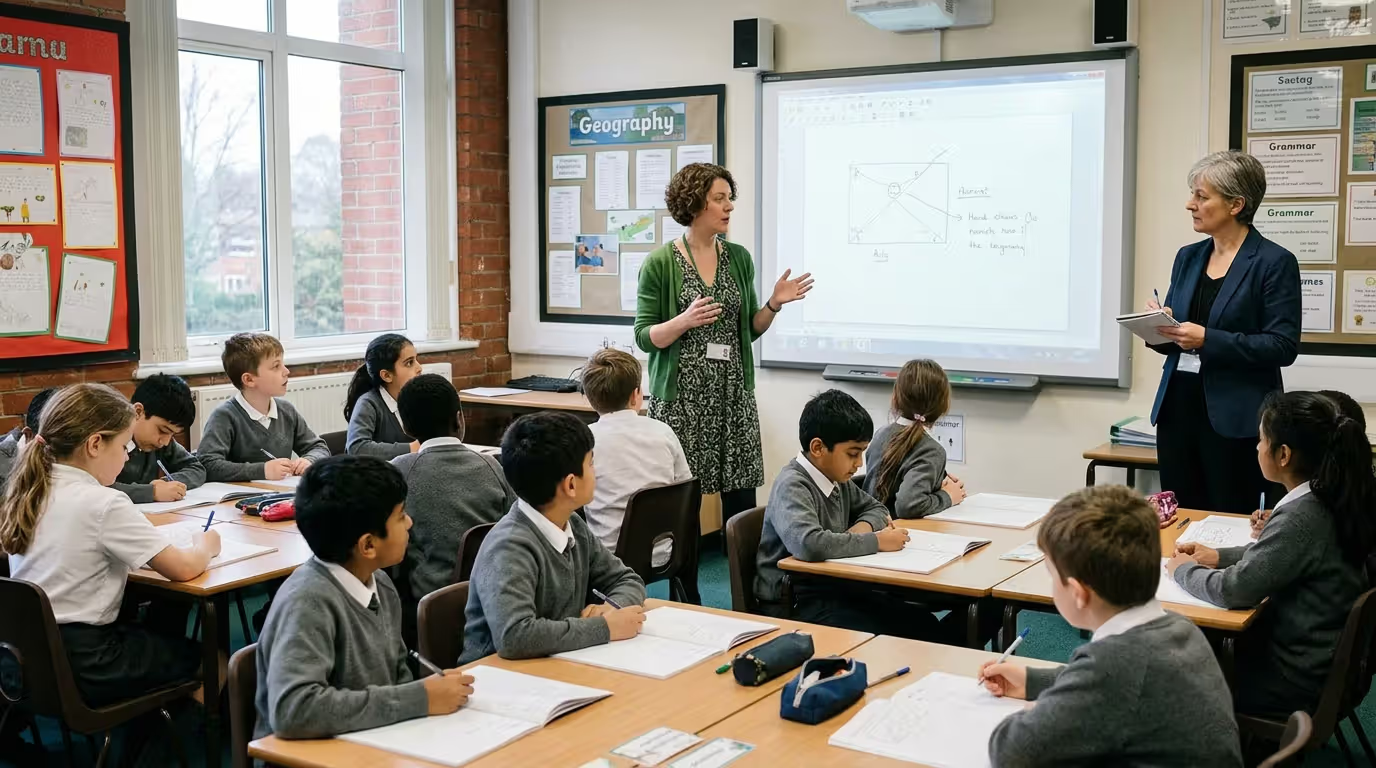
So how does this whole inspection thing actually unfold? The process follows a pattern, though timing varies based on the school's previous rating and type.
Author: Hannah Whitaker;
Source: raynet-merseyside.net
Notification and Preparation
Schools get roughly one day's heads-up before inspectors show up. Sometimes it's just an afternoon phone call saying "we'll be there tomorrow morning." This tight timeline is deliberate—Ofsted wants to see normal operations, not a carefully staged performance.
Here's something that changed recently: outstanding schools used to be exempt from routine inspections. Not anymore. Now every school gets inspected eventually, though top-rated schools might wait longer between visits.
Inspection Days
Expect two days for most schools. Larger schools might get three. Inspectors arrive before the first bell and often stay past dismissal, watching lessons, examining student work samples, and digging through school records.
The team size depends on the school—usually a lead inspector plus one or more teammates. They're everywhere: classrooms, hallways during transitions, leadership meetings, safeguarding file cabinets, curriculum planning sessions.
What Inspectors Do
They watch lessons across different subjects and age groups. They chat with students in both structured group discussions and casual hallway conversations. Teachers, support staff, and administrators all get interviewed. Inspectors review everything from policies to assessment records to examples of student work from throughout the year.
Parents get a say too. Before inspectors arrive, Ofsted distributes surveys and reviews the responses. They'll also look at whatever parent feedback the school has collected independently.
Report Publication
The detailed report goes live on Ofsted's website roughly 30 days after the inspection wraps. You'll find the overall grade, individual grades for specific judgment areas, narrative explanations of what's working and what isn't, plus specific recommendations.
Can schools appeal? Only if there are factual errors in the report. The actual rating stands until the next inspection cycle.
Understanding Ofsted Ratings and What Each Grade Means
Ofsted works with a four-point scale. Every school gets an overall grade plus separate grades across four judgment categories (more on those in a minute).
Outstanding School Ofsted Rating
This is grade 1—the top of the mountain. It signals that a school delivers exceptional education and goes well beyond meeting basic standards.
What pushes a school into outstanding territory? Inspectors want to see teaching excellence across the board, not just in a few star teachers' classrooms. They're looking for ambitious curriculum design that challenges every student. Student outcomes need to be exceptional regardless of background or starting point. Leadership must drive genuine, continuous improvement rather than just maintaining the status quo.
You'll typically see students making rapid, sustained progress in these schools. Kids are genuinely enthusiastic about learning—you can see it in their faces and hear it in their questions. They're exceptionally well-prepared for whatever comes next, whether that's secondary school or university. Behavior is exemplary without feeling oppressive or overly controlled.
Only about one in five schools in England holds this rating. It's genuinely difficult to achieve and even harder to maintain over time.
Good School Rating
Grade 2—good—is where the majority of schools land. It's a solid, respectable rating indicating the school meets high standards and serves students effectively.
Schools rated good provide effective teaching, well-structured curriculum, positive outcomes for students, and competent leadership. Students are safe, behavior is generally positive throughout the day, and most pupils make expected or better-than-expected progress.
What separates good from outstanding? Often it's about consistency and ambition. A good school might have pockets of brilliance but not uniformly across all subjects or year groups. Or maybe they meet standards reliably without pushing boundaries or innovating.
Here's something worth remembering: don't write off good schools. Many deliver excellent education in supportive, nurturing environments. I've seen plenty of good schools with strong community connections and stable leadership that actually serve families better than outstanding schools going through leadership transitions or trying to maintain an unsustainable pace.
Requires Improvement and Inadequate Ratings
Grade 3—requires improvement—sits in the middle. The school isn't failing, but it's not good yet either. Inspectors spotted significant issues that need addressing.
Common problems include inconsistent teaching quality (some teachers are strong, others struggle), gaps in curriculum coverage, or leadership challenges. Student outcomes might vary widely between different demographic groups. Behavior might be acceptable overall but inconsistent from class to class or day to day.
Schools with this rating face more frequent inspections—typically within 30 months. They need to demonstrate clear progress or risk dropping to inadequate.
Grade 4—inadequate—is the bottom tier. The school is failing to provide acceptable education, or there are serious safeguarding concerns that put children at risk.
Schools rated inadequate face immediate intervention. They might receive a notice to improve or, in serious cases, get placed in special measures. Leadership typically changes. The school often gets forced to convert to academy status under a new sponsor organization.
Parents have the right to request transfers to other schools when their child's school is rated inadequate, though actually finding available spots nearby can be challenging.
Key Ofsted Inspection Criteria and Judgment Areas
Ofsted evaluates schools across four main categories. Each gets its own individual grade, and these four grades inform the overall rating.
| Judgment Area | What Inspectors Assess |
| Quality of Education | How curriculum is designed and delivered; teaching effectiveness across subjects; whether students truly learn and retain content over time; access to ambitious curriculum for all students regardless of background; how assessment informs teaching; subject knowledge and expertise of teaching staff |
| Behavior and Attitudes | Student conduct during lessons and throughout the building; attitudes toward learning and engagement; attendance patterns and punctuality; how bullying is prevented and addressed when it occurs; exclusion rates and whether certain groups are disproportionately affected; mutual respect among students and between students and staff |
| Personal Development | Education beyond academics; character development opportunities; preparation for life in modern Britain; understanding of healthy relationships and consent; careers guidance quality and accessibility; extracurricular and enrichment opportunities; spiritual, moral, social, and cultural development |
| Leadership and Management | Vision and ambition for every student; curriculum decisions and rationale; staff workload and well-being; governance quality and accountability structures; safeguarding effectiveness and culture; resource allocation; partnerships with parents and the broader community |

Author: Hannah Whitaker;
Source: raynet-merseyside.net
Quality of education typically carries the heaviest weight. You simply cannot receive an outstanding overall rating without an outstanding grade here—it's the school's core purpose, after all.
But the other three areas matter tremendously. Excellent teaching combined with serious behavior problems won't produce a high rating. Similarly, strong academics without attention to personal development or sustainable leadership raises red flags.
Inspectors also pay close attention to how well schools serve disadvantaged students and those with special educational needs. Achievement gaps between different student groups can drag down ratings even when overall outcomes look impressive.
Inspection is not a perfect science, but it provides a vital snapshot of a school's effectiveness at a particular moment. The best schools use inspection not as a judgment to fear but as an opportunity to reflect and improve.
— Wilshaw Sir Michael
How to Read and Interpret Ofsted Reports
The headline grade gets all the attention, but the full report tells a much richer story. Here's where to focus your attention when you're actually reading through one.
Publication Date
Start by checking when inspectors actually visited. A three-year-old outstanding rating might not reflect today's reality if the head teacher left, half the staff turned over, or the school expanded significantly. Schools evolve—sometimes dramatically—between inspection cycles.
The Main Findings Section
This summary appears near the beginning and captures the most important strengths and concerns. Read this section carefully. It often reveals nuances that the overall grade masks completely.
For instance, a school rated good might have outstanding personal development but inconsistent math instruction. Or a school requiring improvement might have strong new leadership that's driving rapid positive change.
What the School Does Well
This section highlights specific strengths with concrete examples. Look for detailed observations rather than vague praise. "Year 6 students confidently analyze complex themes in Shakespeare and articulate their interpretations" tells you far more than "reading instruction is strong."
What the School Should Do to Improve
These recommendations reveal what's not working yet. Even outstanding schools get suggestions for improvement. The key question is whether you're looking at minor refinements or fundamental problems.
Watch for red flags like safeguarding concerns, wide achievement gaps between demographic groups, high staff turnover, poor behavior management systems, or weak governance.
Subject-Specific Commentary
Reports often include observations about particular subjects. If your child has specific interests or learning needs, this matters. A school might be good overall while having weak foreign language provision or struggling science teaching.
Safeguarding
Every report includes a safeguarding judgment—it's basically pass/fail. Either arrangements are effective or they're not. Any concerns in this area are extremely serious.
Limitations of Ofsted Ratings Parents Should Know
Ofsted ratings provide valuable information, but they're far from the complete picture. Here's what gets missed.

Author: Hannah Whitaker;
Source: raynet-merseyside.net
The Snapshot Problem
Inspectors spend two days in a school—maybe three for a large school. That's a tiny slice of school life. A school might rise to the occasion under inspection pressure but struggle with consistency day-to-day. Or inspectors might happen to visit during an atypical week that doesn't represent normal operations.
Timing Matters
A school rated requires improvement two years ago might have completely transformed under dynamic new leadership. On the flip side, an outstanding school from four years ago might be coasting on reputation while quality quietly erodes.
Context Gets Lost
Schools serving challenging demographics often work significantly harder to achieve the same ratings as schools in affluent areas with engaged, well-resourced families. A good rating in a high-poverty neighborhood might actually represent more impressive educational work than an outstanding rating in a wealthy suburb with every advantage.
Ofsted attempts to account for context, but it's an imperfect science. Raw ratings don't always reflect value-added or the significant obstacles some schools overcome daily.
The Curriculum Narrowing Effect
Some schools focus intensely on what Ofsted measures, potentially sacrificing things that matter but don't show up prominently in inspections. Music programs, art instruction, field trips, and creative projects sometimes get sidelined in favor of test preparation and inspection-friendly activities.
Teacher and Parent Perspectives
The inspection process doesn't deeply capture day-to-day relationships, community atmosphere, or how responsive the school is to individual student needs. These factors profoundly shape your child's actual experience but don't always surface in inspection criteria.
Special Needs Provision
While inspectors examine SEND (special educational needs and disabilities) provision, a brief visit cannot fully assess how well a school supports students with specific needs. You'll need to investigate this much more thoroughly on your own.
What Parents Should Ask Beyond Ofsted Scores
You've read the Ofsted report. Now what else should you investigate before making a decision?
School Culture and Values
Try to visit during a regular school day if the school allows it. Observe how students interact during break times. Do they seem genuinely happy and engaged? How do staff members speak to students—with warmth and respect, or something else? Does the environment feel nurturing or rigid?
Talk to current parents if you can find them. They'll share insights no report captures: how conflicts get resolved, whether teachers are genuinely approachable, if the school truly welcomes parent involvement or just pretends to.
Teacher Retention and Stability
High staff turnover disrupts learning and frequently signals underlying problems. Ask how long the head teacher has been in their role and what percentage of teachers return each year.
New teachers aren't necessarily problematic—but constant staff churn is definitely a warning sign.
Extracurricular Opportunities
What clubs, sports teams, and enrichment activities does the school actually offer? Are they accessible to all students, or only those whose parents can pay fees or provide transportation?
These programs develop skills and relationships that matter just as much as academics in the long run.
Communication and Responsiveness
How does the school communicate with parents? Is there a transparent process for raising concerns when they arise? Do they respond to questions and issues promptly?
Try emailing or calling with a question before enrolling. How they respond tells you volumes about what to expect.
Special Needs and Differentiation
If your child has learning differences, ask pointed questions: What's the SEND coordinator's training and experience? How do they adapt curriculum and instruction? What specific support is actually available?
Don't accept vague reassurances. Push for concrete examples.
Homework and Assessment Philosophy
Schools vary dramatically in homework expectations and assessment approaches. Confirm their philosophy matches your values and your child's learning needs.
Transition Support
How does the school help new students settle in during their first weeks? What about transitions between key stages? Strong transition support makes an enormous difference, particularly for anxious children.
Diversity and Inclusion
How does the school's demographic composition compare to the broader community? How do they address bullying, especially around race, religion, or LGBTQ+ identity?
Look at curriculum materials and displays throughout the building. Do they reflect diverse perspectives and experiences authentically?

Author: Hannah Whitaker;
Source: raynet-merseyside.net
Frequently Asked Questions About Ofsted School Ratings