
Understanding logical thinking
What Is the Concrete Operational Stage?

Content
Picture this: your daughter insists her brother got more juice because his glass is taller—even though she watched you pour equal amounts. Two months later, she rolls her eyes at the same trick. "Nice try, Mom. It's the same juice, just a different glass."
That shift? That's the concrete operational stage kicking in.
Understanding the Concrete Operational Stage
Jean Piaget mapped out four distinct periods of cognitive growth, and the concrete operational phase sits right in the middle as phase three. This is when kids finally develop the mental machinery to apply logic to things they can physically interact with—objects they can hold, see, or move around.
Think of it as the gap-filler between early childhood (where imagination runs wild but logic takes a backseat) and the teenage years (when abstract thinking finally shows up). A five-year-old might genuinely believe that if you spread pennies farther apart, you've somehow created more money. An eight-year-old? They'll look at you like you've lost your mind.
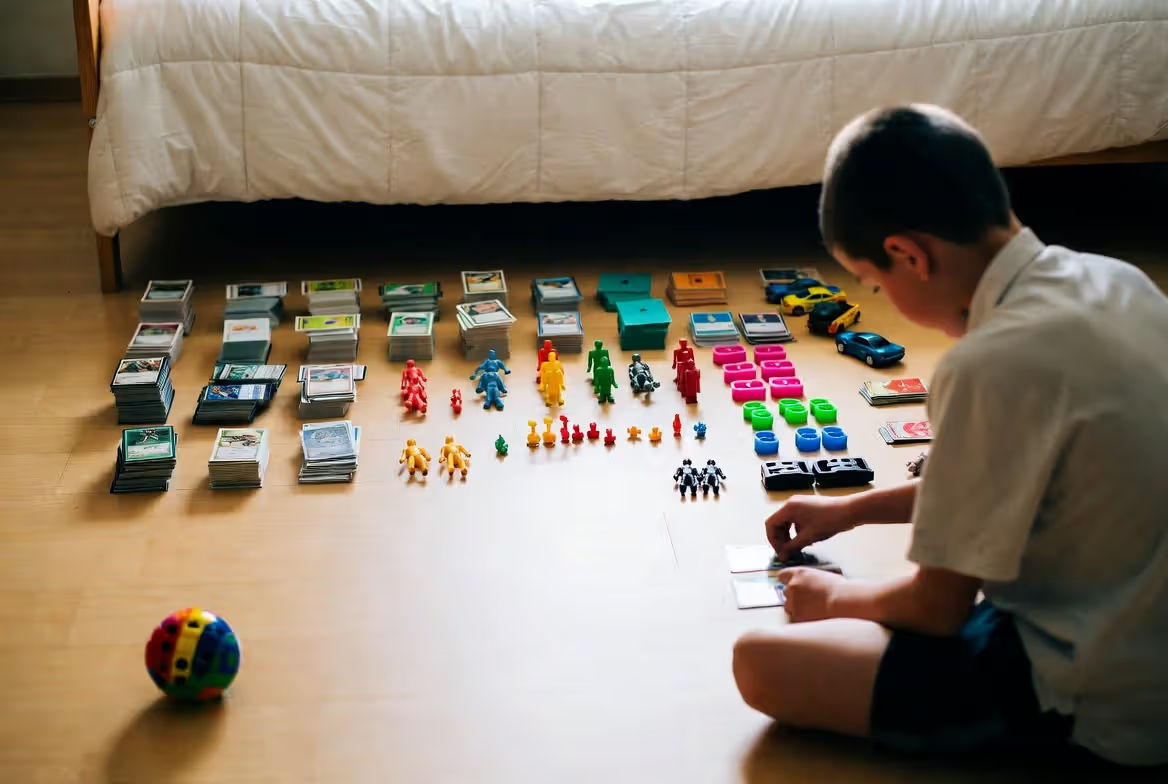
Why does this matter so much? Because it completely rewires how children tackle learning. Instead of making wild guesses based on what things look like, they start using systematic thinking. Math teachers suddenly see kids handling problems with multiple steps. Parents notice their children can sort Pokemon cards by type, evolution stage, AND rarity—all at once.
Middle childhood cognitive development during these years creates the scaffolding for pretty much everything academic. Kids pick up essential mental tools: sorting information into categories, working backwards through problems, and recognizing when their eyes are playing tricks on them.
This stage isn't just about becoming "smarter." It's more like upgrading from a flip phone to a smartphone—same kid, totally different processing power.

Author: Hannah Whitaker;
Source: raynet-merseyside.net
Age Range and Timeline of Concrete Operational Thinking
Most children hit the concrete operational stage age range somewhere between 7 and 11 years old. But I'm giving you averages here, not iron-clad rules.
I've seen plenty of kids showing concrete operational thinking at 5 or 6. Others don't really get there until they're pushing 9. Educational opportunities, cultural background, and plain old individual wiring all play a role.
The shift from preoperational to concrete operational thinking crawls along gradually. You won't see your six-year-old go to bed one night and wake up a logic machine. Instead, you'll catch small changes spread across months.
Maybe they nail conservation with liquids first, then six months later they get it with solid objects. They might understand reversibility when adding numbers before they grasp it with spatial problems. In my experience, these abilities don't all flip on like light switches—they flicker on one at a time, sometimes in surprising order.
What signals the transition? Watch for these shifts:
Appearances stop being the whole story. That tall skinny glass doesn't automatically win the "which has more" contest anymore.
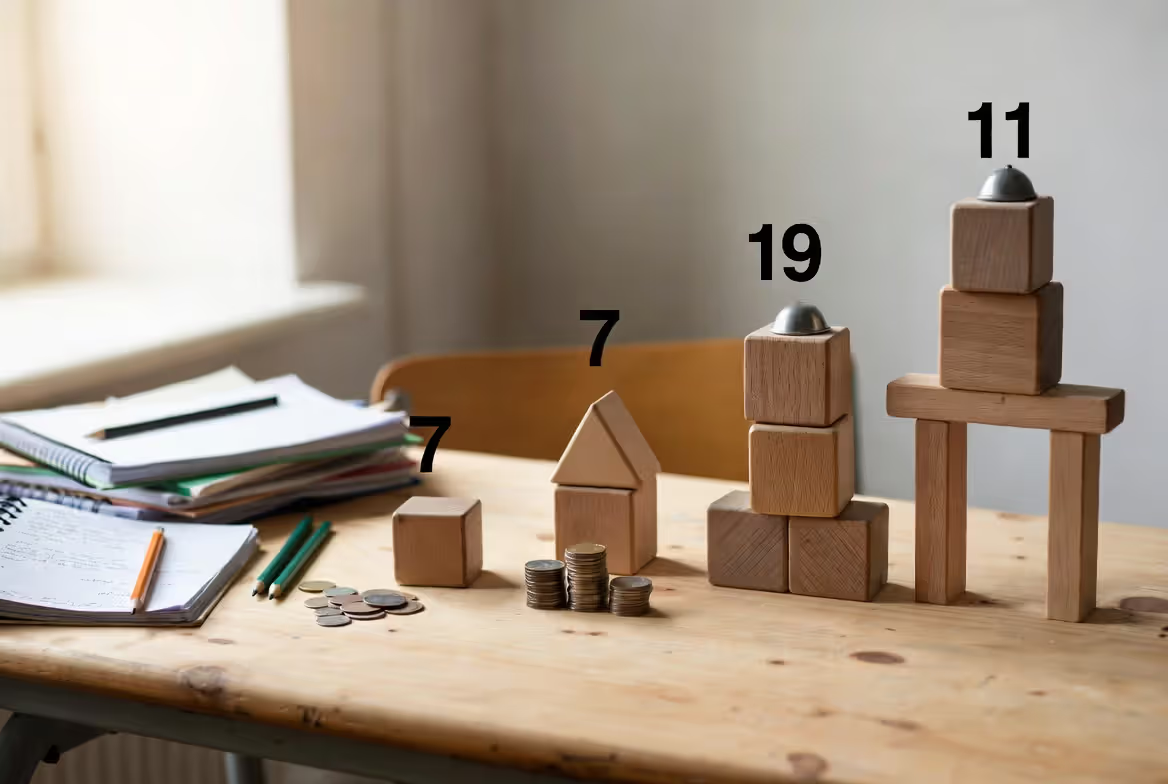
They can run operations backwards in their heads. If 5 + 3 gets you to 8, then 8 - 3 obviously gets you back to 5.
They grasp that one thing can fit multiple categories at once. A golden retriever is simultaneously a dog, an animal, a pet, and a mammal.
That endpoint around 11 or 12? Also flexible. Some kids start dabbling in formal operational thinking earlier, while others stick with concrete operational thinking well into high school for certain types of problems.
Author: Hannah Whitaker;
Source: raynet-merseyside.net
Key Cognitive Skills That Emerge During This Stage
Conservation Tasks and Understanding
Piaget's conservation tasks still work as the best litmus test for concrete operational thinking. Conservation boils down to this: certain qualities don't change even when appearances do.
Piaget created several conservation tests:
Number conservation: Set up two rows of pennies with identical counts. Spread one row wider, and younger kids swear the longer row has more pennies. Kids in the concrete operational stage? They know better.
Liquid conservation: Transfer water from a short, fat container into a tall, skinny one. Little kids fixate on the height and insist you've created more water. Concrete operational kids recognize you've just moved the same amount around.
Mass conservation: Take a clay ball and roll it into a snake shape. Younger children often claim you've made more clay because it's longer now. Concrete operational children understand the quantity hasn't budged.
Here's the kicker—children typically crack different conservation puzzles at different ages. Number conservation usually clicks first, around 6 or 7. Mass and liquid conservation trail behind. Volume conservation often doesn't land until age 10 or even 11.

Author: Hannah Whitaker;
Source: raynet-merseyside.net
Classification and Categorization Abilities
Classification skills in children absolutely explode during this stage. Before concrete operations, kids crash and burn on class inclusion problems.
Classic example: Show a child eight daisies and three roses. Ask them, "Are there more daisies or more flowers?" Younger kids typically answer "more daisies" because they can't hold the subcategory (daisies) and the umbrella category (flowers) in their minds simultaneously.
Concrete operational children breeze through this. They've mastered hierarchical classification.
They can also sort stuff using multiple criteria at once. Hand them a bucket of blocks in various colors, shapes, and sizes, and they'll build intricate sorting systems: big red circles here, tiny blue triangles there.
This ability revolutionizes how children organize their world. Those chaotic toy boxes transform into elaborate filing systems. Schoolwork gets tackled with actual structure.
Seriation Skills
Seriation in child development means putting things in order based on some measurable quality—height, weight, darkness, temperature, whatever.
Before concrete operations, kids fumble with ordered sequences. Ask a five-year-old to line up sticks from shortest to tallest, and you'll probably get two piles: "short sticks" and "long sticks," with no smooth progression between them.
Concrete operational children attack this methodically. They'll develop strategies like picking the shortest stick first, then hunting for the next shortest, building the sequence piece by piece.
This skill stretches beyond physical objects. Children can sequence events in time order, line up numbers from smallest to largest, and grasp comparative terms like "heavier than" or "lighter than" when dealing with series.
Reversibility in Logical Thinking
Piaget flagged reversibility as one of the make-or-break signs of concrete operational thinking. It's grasping that you can undo actions mentally and get back where you started.
Mathematical reversibility becomes crystal clear during this stage. Children finally understand that addition and subtraction work as opposites. If 7 + 5 equals 12, then 12 - 5 has to equal 7. Sounds obvious to grown-ups, but it represents a genuine mental breakthrough.
Spatial reversibility develops alongside it. A child can mentally trace their route to school, then flip it around to figure out the way home. They get that three right turns can be cancelled out by three left turns.
This ability props up pretty much all logical thinking in children. Without reversibility, genuine logical operations stay out of reach.
Real-World Examples of Concrete Operational Stage Behaviors
Concrete operational stage examples pop up everywhere once you're tuned in.
In the kitchen: Your eight-year-old watches you slice a pizza into twelve pieces instead of six. She doesn't freak out thinking there's suddenly less pizza to go around—she knows the total amount hasn't changed regardless of how you slice it.
During homework: A third-grader tackles multiplication problems with actual logic. If 9 × 4 equals 36, he figures that 9 × 5 must be 36 plus another 9. He's applying reversibility and spotting relationships between operations.
At the store: A ten-year-old compares prices with real strategy, recognizing that buying three items at $2 apiece costs exactly the same as grabbing two items at $3 each. She's juggling conservation of quantity and reversibility simultaneously.
Playing games: Kids this age go crazy for rule-based strategy games. They can juggle multiple game conditions in their heads at once and actually plan several moves ahead. Chess, checkers, and complicated card games become genuinely fun because they can think through logical chains.
Organizing collections: Whether they're hoarding rocks, baseball cards, or Lego minifigures, concrete operational children build sophisticated classification systems. They might sort by category, then by size within each category, then by condition within each size group.
Understanding time: A nine-year-old grasps that Grandma was once Mom's age, and Mom was once her age. She can mentally run time backwards and forwards, understanding everyone's relative position on the timeline.
Solving everyday problems: When their toy rolls under the couch, a concrete operational thinker tries different retrieval approaches systematically: reaching from the left side, then the right, grabbing a yardstick, tilting the couch. They work through problems logically instead of just repeating the same failed attempt over and over.
Here's where parents trip up: expecting abstract reasoning during this stage. A ten-year-old can explain why stealing from their sibling is wrong, but ask them to discuss the philosophical nature of property rights and you'll get blank stares. They handle logic beautifully with concrete situations, not hypothetical abstractions.
Author: Hannah Whitaker;
Source: raynet-merseyside.net
How Concrete Operational Thinking Differs from Other Stages
Seeing where concrete operational thinking fits in the bigger picture clarifies what children can and can't handle.
Compared to the preoperational stage (ages 2-7):
Preoperational kids are locked into their own perspective—seeing things from someone else's viewpoint is genuinely hard for them. Concrete operational children can step into another person's shoes, at least when dealing with real situations.
Preoperational thinking runs on gut feelings and what things look like. If something appears bigger, it IS bigger, end of story. Concrete operational thinking uses logic to see past misleading appearances.
Preoperational children can't mentally reverse actions. Concrete operational children do it automatically.
Compared to the formal operational stage (age 11+):
Concrete operational thinkers need actual objects or real scenarios to reason about. Purely hypothetical situations leave them stumped.
Try asking a nine-year-old, "What if humans had evolved to breathe underwater instead of air?" and you'll probably get a silly answer or confusion. They can't systematically explore scenarios that don't exist.
Formal operational thinkers wrestle with abstract ideas like justice, infinity, or algebraic variables without breaking a sweat. Concrete operational thinkers need something concrete to anchor their thinking.
Scientific reasoning differs dramatically too. A concrete operational child can run simple experiments, but controlling all variables or thinking through every possible combination systematically? That's still too much.
Here's a practical comparison:
Problem: "If all fleebs are glorps, and all glorps are zindles, are all fleebs zindles?"
Preoperational response: Total confusion or random guessing.
Concrete operational response: Might crack it if you swap in real objects or familiar categories, but pure abstraction throws them off.
Formal operational response: Solves it instantly through logical deduction.
The concrete operational stage hits a sweet spot for certain learning types. Children can handle logical operations without getting buried under abstract complexity. They're primed for systematic instruction in math, science, and structured problem-solving.
Supporting Cognitive Development in Middle Childhood

Author: Hannah Whitaker;
Source: raynet-merseyside.net
You can't shove a child into concrete operational thinking before their brain's ready, but you can absolutely create environments that nurture this development.
Hands-on learning beats lectures every time. Abstract explanations don't match how concrete operational children process information. Give them stuff to manipulate, experiments to run, and problems to solve with actual materials.
Ask questions that spark logical thinking: "What made that happen?" "If we switched this part, what would change?" "How can you prove they're equal?" These questions push children to explain their reasoning out loud.
Play strategy games as a family. Chess, checkers, Mastermind, and logic puzzles all exercise concrete operational skills. Memory-based card games help too.
Support collections and sorting. Whether they're gathering leaves, rocks, stamps, or bottle caps, organizing and categorizing exercises classification skills naturally.
Cook and bake as a team. Recipes involve measuring, conservation of quantity, and following sequences. Doubling a recipe exercises proportional reasoning without feeling like homework.
Run science experiments together. Simple experiments with obvious cause-and-effect help children practice logical thinking. Growing plants, mixing baking soda and vinegar, or building simple machines all work beautifully.
Use actual money for math practice. Concrete operational children grasp mathematical concepts way better with real coins and bills than with abstract numbers on worksheets.
Read mystery books together. Following clues and cracking cases exercises logical deduction in an engaging package.
Don't push abstract concepts prematurely. If your child isn't ready for algebra or abstract philosophical debates, relax. They'll get there.
Here's the thing—simpler usually wins. You don't need expensive educational programs. Regular activities involving logical thinking, hands-on manipulation, and problem-solving support concrete operational development naturally.
Counterintuitive tip: sometimes explaining less works better. Instead of lecturing about why liquid quantity stays constant when you pour it into different containers, let children pour it back and forth themselves. Discovery often teaches more effectively than explanation ever could.
The principal goal of education in the schools should be creating men and women who are capable of doing new things, not simply repeating what other generations have done.
— Jean Piaget
| Cognitive Skill | Definition | Example | Age Typically Mastered |
| Conservation | Grasping that quantities stay identical despite changes in how they look | Knowing that juice poured from a short wide cup into a tall skinny glass is still the same amount | 7-8 years |
| Classification | Organizing items into groups and grasping how categories nest inside larger categories | Sorting animals into mammals, reptiles, and birds, then creating subcategories within each | 7-9 years |
| Seriation | Putting items in sequence based on a measurable quality | Lining up pencils from shortest to longest or putting events in chronological order | 7-8 years |
| Reversibility | Grasping that you can mentally undo actions and return to where you started | Knowing that if 8 + 4 gets you to 12, then 12 - 4 brings you back to 8 | 7-9 years |
| Decentration | Considering multiple features of a situation at the same time | Understanding that something can be heavy AND small simultaneously | 7-10 years |
| Transitivity | Grasping logical relationships between items in a sequence | If A is bigger than B, and B is bigger than C, then A must be bigger than C | 8-10 years |
FAQ: Concrete Operational Stage Questions Answered